A broadly held concern about rising home prices is that rising prices fuel unsustainable consumption spending when households tap home equity to spend more. Here is a
new article on the subject in Australia (HT:
John Wake). The article mentions research that claims 24% of each dollar in capital gains are taken by owners in new debt. This is similar to an
estimate by Mian and Sufi.
I think, on this topic, it is important to distinguish between real (making stuff) and nominal (exchanging money for stuff) economic activity. This is purely a nominal issue. So, I think instead of framing this as an issue of households overconsuming in an unsustainable way, it is more accurate to say that, of the stuff we were making, real estate beneficiaries were claiming more of it, at the expense of people who were producing stuff. That should be inflationary. And, if it is not, then it means that the central bank is counteracting the phenomenon with tight money.
Whatever the inflation effect, real estate owners were consuming, in the real sense, at the expense of producers.
The research referenced in the article also mentions that real estate gains draw some owners out of the labor force because of their newfound wealth. This makes sense. But, again, thinking about this in terms of real economic claims on production, we might expect a similar rise in labor force participation among producers whose incomes are now vying for a smaller portion of production.
In fact, during the housing "bubble", labor force participation was quite strong. I have done a lot of work on this blog in the past showing how demographics are responsible for much of the drop in labor force participation, recently. Here, just as a quick and dirty way to try to control for that, I am using prime age male labor force participation. There is a long term downtrend, but after we account for that, we can see that labor force participation was strong.
This makes sense to me, because I don't think credit supply or irrational speculation have much to do with the housing "bubble". I think it mostly had to do with high skilled working people buying access into the Closed Access labor markets where limited housing serves as a gatekeeper. So, there while there was certainly some amount of typical labor force reductions because of capital gains, many of the households utilizing gains from those homes for consumption were in those homes specifically
to work.
In any case, I don't see much cause for even bringing the central bank into this. From the point of view of consumers who don't have access to these capital gains, this seems like a real shock. There is less production for them to claim. That is going to be the case regardless of the inflation rate. Monetary policy can't solve the problem of unsustainable consumption, even if that is what is happening.
But, households can't unsustainably consume, domestically. They can only change their relative claims on existing production. Here, the trade deficit seems to suggest unsustainability. In effect, foreign capital was flooding into our capital markets, helping to push up home prices, so that, in effect, we were borrowing from foreigners in order to buy production from foreigners, and this is why it was unsustainable.
And, this is why a clear understanding of what has been happening in foreign trade and investment is key. It is true that the trade deficit ballooned during the housing "bubble" as foreign investment flooded into the US. But, at the same time, US net income on foreign investment was also strong and positive. If we were hawking our futures for unsustainable consumption, then our net foreign income should have dropped as foreign savers claimed their profits from our borrowing. Considering the significant spike in net imports, this should be a shocking piece of evidence.
The explanation for this is that the causation goes the other way. Closed Access exclusion supports excessive wages and profits in the Closed Access cities. Many of those profits are earned overseas. Those Closed Access incomes were the cause of high home prices, the cause of rising foreign income, and the cause of foreign capital inflows. And, they funded those imports. Even with the continued high trade deficit, net foreign income for US savers is high.
Yet, again, whether this consumption was sustainable or not, what does the central bank have to do with it? That will be the case regardless of the rate of inflation. The only way for monetary policy to cut into this consumption is to create a real shock large enough to induce retrenchment. This is basically what we did.
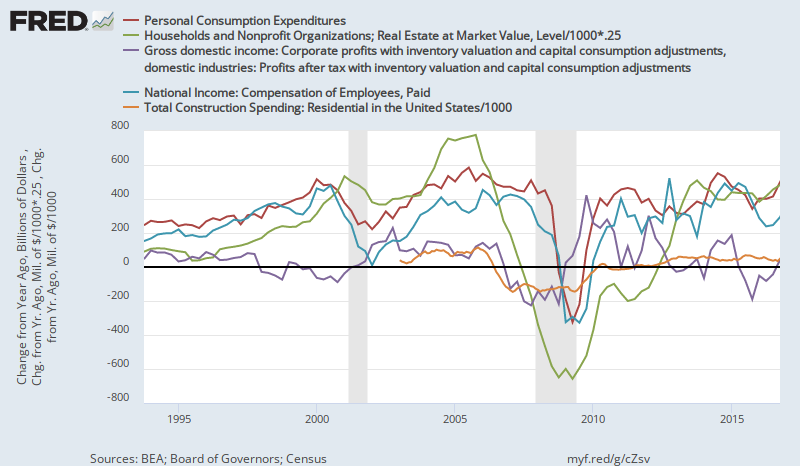
Here is a graph of the year-over-year growth in personal consumption expenditures (red). I have also included the growth in mortgages outstanding, then I deducted residential investment in single family structures to estimate the amount of new mortgages that were coming out of capital gains on existing housing units (blue). I also include a measure of one quarter of the increase in the value of existing real estate, to estimate the amount of capital gains that are claimed by owners for consumption.
For the period from 2001 to 2006, this growth in mortgage credit accounts for the entire growth in PCE. Might it have been the case that homeowners with windfall gains were claiming all of the marginal new consumption since 2001? Could it be that producers (workers and investors) didn't increase their consumption at all - even in nominal terms - during the housing boom? Could it be that they were working harder just so they could produce more for the housing windfall spenders?*
Mian & Sufi do estimate that 2.8% of GDP was funded by home equity borrowing every year from 2002 to 2006. That's enough to cover the growth in personal consumption expenditures shown above.
Again, short of causing a real shock to incomes, I'm not sure what monetary policy could do about this. A rise or drop in inflation would have presumably increased or decreased nominal spending from both the windfall spenders and producers.
As we can see in the graph, real estate values were the first thing to stop expanding. We might expect some stickiness in the willingness of households to continue tapping home equity for consumption. So, mortgage expansion continued until early 2008. And, PCE growth continued to expand along with mortgage growth. So, for most of 2006 and 2007, marginal new consumption was still being claimed by homeowners, but now it was coming at the expense of home equity.
But, as I have documented, at this point, much of this equity harvesting wasn't from continuing homeowners. There was a spike of
selling out of homeownership. The homeownership rate was declining, even though the natural inflow of first time buyers tends to be fairly stable. This meant that housing starts were collapsing and the typical owner of the housing stock was becoming more leveraged, just because long time owners were being replaced by new owners. We can see this where total growth in gross mortgages outstanding was dropping much faster than mortgages outstanding net of new investment.
Here is a similar graph, but here, I have added annualized residential investment and year-over-year growth in compensation and after tax domestic corporate profit. Here, notice that growth in compensation also nearly adds up to the growth in PCE. So, between the growth in mortgages and the growth in compensation, consumption is more than accounted for.
This is because much of that mortgage growth and consumption growth was funding savings. The way it was funding savings was that first time homebuyers were buying homes from long term homeowners who were exiting homeownership. This created significant new mortgage debt. But, the former home equity of those former home owners wasn't being consumed. It was being saved. Much of it was
funding CDOs. This didn't show up as savings, because we don't tend to count capital gains as savings. But, there was a lot of savings flowing out of home equity and into fixed income securities.
Notice that compensation and PCE dropped together in 2008 about when mortgage growth dropped. Mortgage growth dropped after the private securitization market collapsed in summer 2007. At that point, a financial crisis had begun to build, and the Fed was making emergency loans to troubled financial firms. From summer 2007 until they were running out of treasuries to sell in September 2008, they were "sterilizing" those loans. In other words, they were trying to save banks without actually injecting cash into the economy.
But, if consumption was being facilitated by real estate gains and expanding mortgages, then really, from 2004 to 2007, the Fed had already been sort of sterilizing the money supply, sucking out currency to make up for the extra consumption that was funded by real estate gains. When the private securitization market collapsed, if estimates of homeowner debt utilization are accurate, then when the Fed was sterilizing their emergency loans in order to avoid providing money to the economy, they should have been shoveling massive amounts of cash into the economy to make up for the drop in nominal spending.
It isn't the Fed's job to impose a negative shock to make up for past consumption. It's the Fed's job to provide stability. In fact, I submit that the Fed should have been providing more accommodation back in 2006 when home equity started to dive. This sharp increase in homeowner leverage was already a sign of dislocation. We can see in the graph above that, while compensation didn't suffer much from that dislocation, domestic corporate profits did. And, we can see the drop in domestic corporate profits was largely due to the collapse in residential investment.
The country thought the trade deficit was unsustainable, residential investment was unsustainable, and home prices were unsustainable, all funded by foreign capital. We were wrong on all counts.
So what kept us afloat between 2006-2008? Those foreign profits. Here is a chart of US corporate foreign profits as a percentage of GDP.
________________
* This transfer of consumption is accounted for, to a certain extent by the high incomes of Closed Access producers. The high incomes of Closed Access workers and firms mean that production from Closed Access industries is more expensive - there is less consumer surplus from those industries. So, some of the reduced real consumption is from producers in the rest of the country, who pay more for Closed Access output. Some of the reduced real consumption is from producers in the Closed Access cities who pay more for housing, leaving less of their incomes for other consumption.